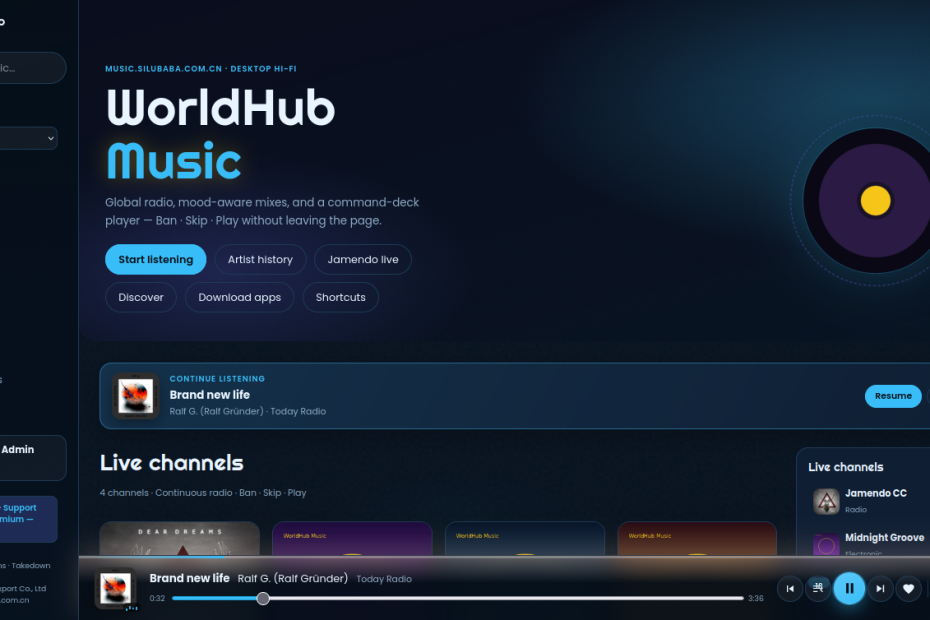
YIWU, China — 13 August 2026 — Most people do not wake up wanting a new “platform.” They want a song to start when they press play. They want the next song ready when they swipe. They want the mix they built last night to exist this morning on the phone they actually carry. They want, if they make music at all, a path from a private sketch to a public page without a week of file-exporting, account-creating, and hoping someone finds the upload.
WorldHub Music is built around those ordinary wants. Operated by Yiwu OOU Import And Export Co., Ltd, it is a single home for listening, collecting, sharing, and making. You can treat it as radio. You can treat it as a personal library. You can treat it as a studio that publishes into the same world you listen in. The public address is https://music.silubaba.com.cn. The studio is https://music.silubaba.com.cn/studio. Applications for phone, tablet, and computer are listed at https://music.silubaba.com.cn/download.
This is a news introduction to the whole system as a person would meet it — not a tour of how the machinery is built. No server names, no player engines, no cache diagrams. Only what it feels like to live there.
The split the product refuses to accept
For twenty years the music internet has asked people to choose a tribe.
One tribe is the lean-back listener. Open a station. Ban what you hate. Skip what you do not want right now. Let a day have a soundtrack. This tribe is large, impatient, and unimpressed by manuals.
The other tribe is the maker. A melody at midnight. A lyric in a notes app. A friend who sings. A hope that the work might be heard by more than the three people in the chat. This tribe is smaller, but it is the source of everything the first tribe eventually plays.
Almost every famous service picked one tribe and nodded politely at the other. Radio apps do not help you finish a song. Studio apps do not feel like a station you would leave on in the kitchen. File lockers do not feel like culture. Social apps do not feel like hi-fi. The listener and the maker keep logging into different rooms, with different passwords, and a different idea of what “done” means.
WorldHub’s public claim is simpler than a revolution. One account should be enough. Enough to hear a channel. Enough to keep favorites for a flight. Enough to hand the same song from a desk to a pocket. Enough, if you write music, to publish into the same catalog your friends already open for pleasure.
That claim only matters if the door is easy. Registration asks for a name, an email, a password, a country, optional tastes, and an agreement to the terms. There is no treasure hunt through a spam folder before the first play. A welcome note and a login notice may arrive from work@silubaba.com.cn. If mail is quiet, the account still works. The product would rather you hear something than prove you can find a six-digit code.
Radio, in the old and useful sense
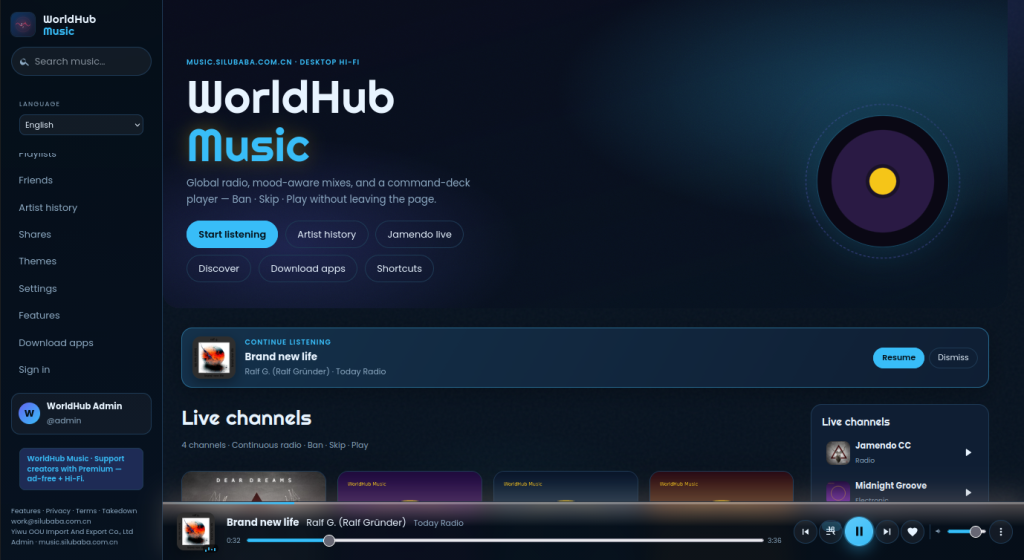
The first screen is not a blank search box daring you to know the name of a song. It is a field of channels — named stations with a mood, a region, a time of day, a reason to exist. You Ban, you Skip, you Play. Those three verbs are the whole grammar of lean-back listening, and WorldHub kept them on purpose.
Ban is not Skip. Skip is “not this minute.” Ban is “not this record in this station’s company.” Anyone who has ever shouted at a radio knows the difference. Software that collapses them into one button is software that does not trust the listener.
Beside the channels sit the rooms people actually wander into:
Discover is the living shop window — what is moving, what is new, who is being found.
Mood is for the day you cannot name a title but can name a feeling: work, night, heat, quiet.
Library is yours: albums you keep, hearts you already gave, playlists you refuse to lose.
Local is the honest drawer: the files already on the machine, the video from last weekend, the folder you have been meaning to play as a list.
Profile is language, plan, downloads, the quiet settings that make a home feel like a home.
Focus, Chill, and Workout are not buried tags. They are ways of walking into the house. A person who only ever opens Workout still belongs. A person who only ever opens a night channel still belongs. WorldHub does not require you to become a curator to deserve music.
On a computer in a browser, the player stays with you as you move around the site. The song is not punished because you clicked Discover. On a small phone browser, the bar is compact: play, skip, heart, queue. Swipe away what you do not want. Open the queue when you do. On the installed application, the same account looks like a proper home screen, with a small now-playing strip that follows you from tab to tab.
None of this is clever for its own sake. It is radio muscle memory in a century that forgot radio was a kindness: music without homework.
Instant, as a feeling, not as a lecture
People do not describe networks. They describe waiting.
They describe the second after a tap when nothing happens. They describe a spinning circle on a bus. They describe a favorite that will not start in a basement. They describe buying a “download” button that still needs a minute. WorldHub’s listening promise, the one you can test without reading a white paper, is: play should begin almost at once, and the second time should feel like the song already lived on your device.
The first time you choose a title the service has never stored for you, you still hear it after a short breath — the length of a glance at the cover, not the length of a kettle. While you listen, the rest of the song quietly becomes yours for later. You are not asked to babysit a progress bar. You are not told to come back when the file is “ready.” Ready is a word for warehouses. Songs should be ready when the chorus is.
The next titles in your queue are treated as guests already taking off their coats. Phone listeners get the next few. Computer listeners get a longer hallway of upcoming tracks. When you swipe, the gap should feel like a cut, not like a confession that the internet is far away.
If you have habits — the same morning sequence, the same walk home, the same artist after the same artist — the service tries to guess without making a speech about guessing. Charging overnight, sitting on home internet, leaving the computer on during work: those are the hours when WorldHub would rather fill in tomorrow’s likely songs than sit idle. You do not apply for this. You simply live a pattern, and the pattern starts meeting you.
Favorites can be gathered for a trip with one decision instead of fifty taps. A screen in your account shows how much room the saved music uses, how often play came from what you already had, and whether you want to keep hearts when you clear space. On a computer you may allow a very large library. On a phone the default is modest, so a first install does not devour the device. When space runs out, the least loved material goes first. What you marked as beloved is last.
There is also a small miracle for rooms with no tower: two WorldHub devices on the same local network can share a song already saved on one of them. A park. A train carriage with a hotspot and no real internet. A festival field. Culture has always moved by being near someone who already had the tape. This is that instinct without the tape.
When the connection is truly poor, a lighter-sounding mode exists so the day can continue. It will not impress a studio loudspeaker. It will get you through a tunnel. The product would rather you hear a thinner song than a perfect silence.
Offline is not a ghetto labelled “Downloads” that you remember too late at the gate. It is the natural result of having listened, plus the extra decision to keep what you love. If you go dark, the saved catalog still plays. That is the whole story a passenger needs.
Words under the voice
A large part of loving a song is knowing what it is saying, or guessing, or mouthing the wrong words for years and not minding.
WorldHub treats lyrics as part of listening, not as a legal PDF. While a track plays, you can see the sung line and, if you want, a translation that follows the language of the menus. An English vocal with a Chinese interface can show both. A person who wants only the original can say so. Karaoke-style highlighting exists for people who came to sing, not only to read.
You choose the language of buttons separately from the language of verses. That sounds like a small courtesy. It is how a household shares a device. One person wants the chrome in French. Another wants to learn the Japanese chorus as it was written. The product should not force those two wishes into a single switch.
Timed words are for practice and pleasure. They are not a claim that every famous lyric on earth is free to reprint. The same rule that governs audio governs text: if you do not have the right to put it here, it does not belong here. WorldHub would rather show a clean original and a clear translation of a song it is allowed to host than decorate a stolen verse.
The studio that publishes into the same house
If WorldHub were only radio, it would be a fine radio. The reason it is a system is Make Music Studio.
The studio is for people who do not merely consume a day of sound. They start something. A bass line. A poem that wants chords. A friend with a MIDI keyboard. A lunch-break sketch that should not die in a private folder. The studio lives in the browser so a school computer, a library machine, or a hotel laptop can still be a place of work. On the Windows, macOS, and Linux applications, Make Music Studio now sits in the left-hand list, under Create, so a listening session and a making session are one glance apart. Tap it and you are in the workshop, signed in as yourself.
You do not need to become an engineer of instruments to begin. You can start from a sentence: the weather of a song, a city, a heartbreak, a tempo that feels like running. The studio will help you toward a shape — sections, melody, words — and let you hear a version that is yours to argue with. You can mix in ordinary language. “Quieter verse.” “Brighter chorus.” “Slow it down.” Undo exists because courage needs a back door.
If you care about tuning the way some people care about spice, the studio does not hide that conversation. You may work in the everyday scale most pop lives in, or you may chase older, purer intervals that make a chord feel like a room with taller windows. You do not have to. The option is a sign of respect for listeners who hear pitch as a place, not only as a piano diagram.
You may plug in a keyboard. You may export a sketch to take elsewhere. You may bounce a listen file and check it on the phone you will actually use on a walk — because a mix that only sounds expensive on studio speakers is a mix that has not met the world. You may invite someone into a live room with a code, the same social instinct as a party playlist, and work on the same piece without mailing a project like a parcel.
When the piece is ready enough to be heard, you publish. Not “export and good luck.” Publish, into WorldHub, as a track that can be shared, collected, tipped, and, if you choose, offered as something exclusive. The listener who Ban/Skips/Plays for fun and the person who stayed up to finish a bridge are finally in the same catalog.
Free makers get a real start: a few projects, a daily allowance of assistance, a few exports, a couple of publishes. People who live here can raise the roof with Premium. Houses that treat WorldHub as a small label can take the highest seat. When you are near a limit, the product says so and points at the plan page. It does not fail in silence and call that mystery.
Learning is allowed to be playful. Short games for ear, rhythm, and note names exist because fear of “not being a musician” kills more songs than lack of talent. A guide opens for a first visit. Six languages cover the chrome, the same six as the rest of the service: English, Chinese, Japanese, Korean, Spanish, French.
The studio is not a claim that every professional stage will now happen in a browser tab. It is a claim that a finished feeling — heard, named, shared — should not require a second career in software.
The files you already own
Streaming services sometimes behave as if the only honest music is the music they rented to you. Life is not like that. There is a concert file from a friend. There is a rehearsal video. There is a decade of purchases. There is a podcast a relative sent. There is a movie clip you wanted to hear through proper speakers.
WorldHub’s Local area treats those objects with dignity. Open several files. Open a folder and let it be a library you can scan again. Play a list you selected with your own hands. Open a network stream if that is what you have. Watch video in the same family of screens. Read lyrics beside a file if a sidecar sits next to it, or fetch words when they are available. Look at what the file actually is — picture, sound, subtitles — when you are the sort of person who wants to know.
On a computer this is especially important. A desk is not only a radio. It is a workbench. WorldHub would rather be the player that opens what you point at than the player that scolds you for not streaming. After a local video, cloud music is supposed to speak again. People should not have to restart their lives because they watched a clip.
Closing the window on a desktop can leave the service in the tray, like a radio you dimmed rather than smashed. Simple global keys pause and skip without hunting a mouse. These are manners. Manners are product.
From room to room without starting over
The modern day is a sequence of screens that do not love each other. A kitchen speaker. A commute. A shop computer. A television. A watch face too small for pride. WorldHub’s answer is an account that remembers the queue.
Continue Here is the phrase on the button, and it is also the ethic. You were on the computer. You pick up the phone. You are not punished with a new random station. You take the same song, the same place in the song, the same list of what was coming next. Quality choices and fades travel with you because they are part of how you listen, not trivia.
A television page can be the loud host in a room. Guests join a party with a code, add songs, vote, take a turn as the person who picks. Friendship on WorldHub is older than “content.” You add someone. They accept. You send an album the way you once sent a mix. Playlists are the furniture of repeatable joy.
A large-button car view exists for people who should not hunt tiny hearts at speed. A watch-sized remote exists for people who want transport without a novel. Voice can ask for something energetic without a thesis about artificial minds. The point is not to impress a conference. The point is that a driver and a cook and a runner are still listeners.
Nearness has two kindnesses and they should not be confused. One is the same account in two rooms — Continue Here. The other is a copy of a song on a nearby device when the internet is a rumor — the local share. Both feel like “nearby.” One is your life following you. The other is a tape passed down the row.
Taste, play, rest, and the softer tools
WorldHub does not need you to believe that a machine knows your soul. It does need to notice what you already did.
If you heart certain artists, return to certain hours, Ban certain textures, the service builds a quiet picture — a Music DNA of tendencies, not a courtroom verdict. You may calibrate how records feel on your headphones, because a bright mix on someone else’s ears is a different record. Home can offer a “today” stream that respects those tendencies. Discover can lean toward what is like what you already loved. You can still Ban. Taste is a suggestion with an escape key.
Karaoke with separated parts — voice out, drums out, the rest for courage — is for the private concert in a rented room and the sudden bravery at a party. A score can exist. Small rewards can exist. Rights still exist: you sing along to what the service is allowed to host. Karaoke is not a loophole. It is a way of loving a track with the body.
Sleep can fade the night down. Wake can fade the morning up. These are the gestures of a house that expects you to be a mammal. Eco is the gesture of a house that expects the tower to fail. Visual joy — moving light while a song runs — is allowed, because some people listen with their eyes slightly open.
None of these extras are the identity of WorldHub. Radio and Studio are the identity. The extras are how a daily companion avoids becoming a blunt instrument.
How a maker might earn a living here
Culture that cannot pay a rent is a hobby with better lighting. WorldHub names three honest ways money can enter without turning the front page into a locked gate.
Membership. Free listening includes the radio verbs and the lighter-sounding mode, with a house message for free accounts where the operator chooses to show one. Premium and the higher seat remove that noise and open higher-quality listening. The highest seat can reach exclusives without needing a private unlock link. Studio capacity rises with the seat. You pay for comfort, quality, and room to work — not for the right to know the service exists. Channel pages remain open to a visitor and to a search page. That is a moral choice as well as a commercial one.
A gentle advertisement on the free path, if the operator configures it. Not a maze. Not a jump-scare over the play button if the team does its job. Paid seats walk past it.
Direct support. A tip. A campaign with a goal. A release only some people hold. A public page for an artist. A studio view of what was heard, what was given, what is exclusive. The house takes a stated share — by default a modest percentage — and shows the split rather than hiding it in folklore. Payouts depend on the operator finishing the ordinary work of being a business. The product at least refuses to pretend that “exposure” is a salary.
The path for a studio user is meant to be a straight hallway: finish, publish, share, receive, raise the seat if the work has outgrown the free desk. A musician should not need a consultant to understand that hallway.
Payments can run through the usual public rails people already trust in their regions, once the operator has opened those doors. Until a door is open, a button should not pretend to charge. WorldHub’s documents treat that as readiness, not as theater.
A catalog with a conscience
The most tempting lie in music software is the infinite shelf: every song you remember, instantly, forever, for a low monthly fee, no questions. That lie is how libraries get stolen and how companies get sued.
WorldHub’s rule is unfashionable and clear. It will not take a commercial radio’s library and call the theft a partnership. A well-known American channel site is mentioned in the family’s design memory as a feeling of browsing stations — cards, Ban, Skip, Play — not as a warehouse to copy. What you hear on WorldHub is supposed to be uploaded by people who have the right to upload, or licensed for this use, or born in the studio as original work.
If you put a recording here, you are responsible for that recording and its picture. If someone believes a work is present without permission, there is a takedown path on the site and a mailbox at work@silubaba.com.cn. An operator console exists so a human can actually act: remove, schedule, import from sources that grant the use, see who is earning. A public music service without a back office is a rumor.
This stance makes WorldHub smaller than a fantasy catalog and larger than a toy. It can grow only as fast as rights and original work grow. That is slower than a scrape. It is the only speed that does not end in a letter from a lawyer and a silent library.
The same person on every screen
A system introduction has to say where the person sits.
In a browser, WorldHub looks like a dark, warm station — gold on a deep stage, a sidebar of rooms, a player that does not panic when you change pages. On a phone in the installed application, it looks like a modern listening home: a few tabs, a large heart, a library, a pocket for files. On Linux it looks like a serious desktop companion, with Recommended, Library, and Create in a left column. On a Mac it aims at the calm of a music application people already trust with their evenings. On Windows it aims at a clear pane and a dark desk. Television, party, car, and watch are companions for rooms that are not desks.
Six languages mean a family can share a household without one member translating the menus out loud. China, Japan, Korea, Spain, France, and the English-speaking web are not “later.” They are now. The studio speaks those languages too, because a maker is not a different species from a listener.
Applications are not a rumor in a repository. They have a download page. A features page exists so a stranger can read, in ordinary language, that this is cloud radio, local listening, handoff between devices, karaoke, taste, a light-data mode, and a studio — without installing anything.
A day in the system, told without machinery
Morning. The phone already knows you often want something gentle before nine. You open WorldHub. A song begins before you have decided to be patient. You Ban one title that is too bright. You Skip one that belongs to another season. You let a third live.
Commute. The next songs were already waiting. The tunnel arrives; Eco keeps a thread of sound. You heart two tracks because the day will need them again.
Work. The computer continues the same queue. You open Local and play a briefing video, then return to the station. Music speaks. You do not reboot your personality.
Lunch. You have fifteen minutes and a melody. Studio. A sentence. A sketch. A friend joins with a code and says the chorus is late. You publish a draft to yourself and walk it on the phone. The mix that felt expensive in headphones feels honest on the street. You change it.
Evening. Friends. A party code on a television. Guests argue in votes. Someone sings with the voice removed. Tips land on a page that is a person, not a corporation’s mood. A child in the house switches the menus to another language and still finds Play.
Night. Sleep fades the volume. The computer keeps a few likely tomorrow-songs while it charges, asking nothing. You did not press “prepare my future.” You only lived.
That day does not require you to know what a server is. It requires WorldHub to have decided, in advance, that waiting is rude, that making belongs beside hearing, and that a catalog must be allowed to exist.
Who stands behind the door
Brand: WorldHub Music
Company: Yiwu OOU Import And Export Co., Ltd
Listen: https://music.silubaba.com.cn
Make: https://music.silubaba.com.cn/studio
Install: https://music.silubaba.com.cn/download
Learn what it offers: https://music.silubaba.com.cn/features
Privacy, terms, and takedown: the site footer
Mail: work@silubaba.com.cn
The news is not that the world gained another icon on a home screen. The news is that a company in Yiwu put radio manners, a maker’s desk, a traveler’s offline bag, and a household’s many devices under one name, and refused the usual bargain — refuse the infinite stolen shelf, refuse the studio that cannot publish, refuse the player that makes you wait as a form of honesty.
WorldHub Music is for people who want a song now, a favorite later without a network, a friend in the queue, and, when the day turns, a way to put a new piece of music into the same house that just played the old one.
Press play. If you have something to say in sound, press further. The rooms are connected on purpose.